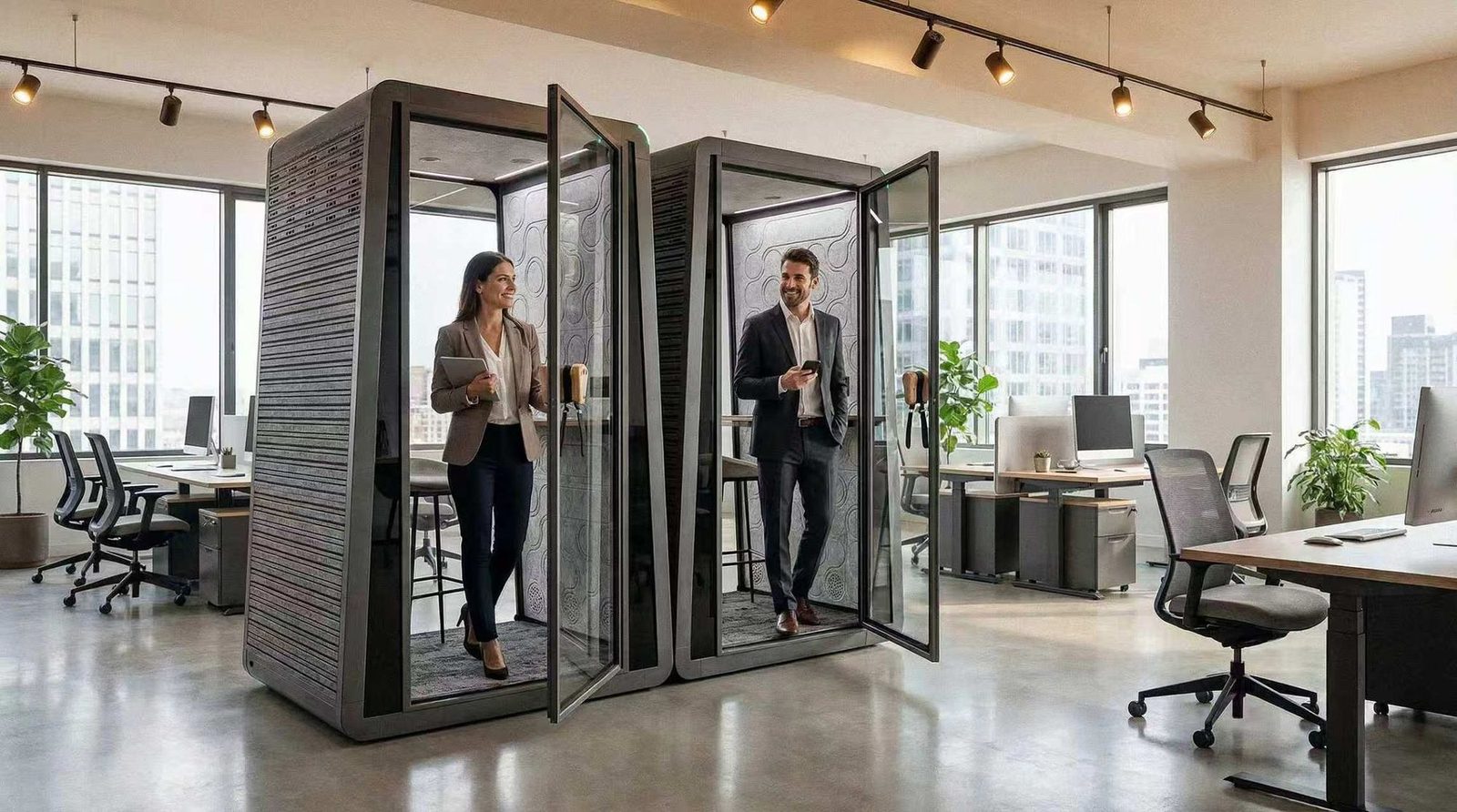
How many dB of sound reduction does a phonebooth need in an open office?
The number to ask for is speech level reduction Ds,A, measured to ISO 23351-1. Not NRC, and not Rw. Class A starts at 30 dB, class B runs from 25 to 30 dB. For everyday calls in an open office, class B is enough. For HR, legal or finance conversations, specify class A. A dB figure without a named standard and a test report number cannot be compared with any other brand figure.
30 dB là ngưỡng lớp A của Ds,A theo ISO 23351-1
<p>A client asks how well the booth blocks sound. The first brand answers 28 dB. The second answers NRC 0.95. The third says up to 30 dB of reduction. Three numbers, none of them comparable with the others.</p>
<h2 id="only-one-quantity-is-comparable-ds-a">Only one quantity is comparable: Ds,A</h2>
<p>ISO 23351-1:2020 is the standard for measuring the speech level reduction of enclosures and furniture ensembles. Its quantity is Ds,A, in dB. The method: a standard speech source plays inside, the level outside is measured with and without the booth, and the difference is the reduction.</p>
<p>This is the only figure that lets you put two brands side by side and compare them.</p>
<div class="wxtblwrap"><table class="wxtbl"><thead><tr><th>Class</th><th>Speech level reduction Ds,A</th></tr></thead><tbody><tr><td>A+</td><td>above 33 dB</td></tr><tr><td>A</td><td>30 to 33 dB</td></tr><tr><td>B</td><td>25 to 30 dB</td></tr><tr><td>C</td><td>20 to 25 dB</td></tr><tr><td>D</td><td>15 to 20 dB</td></tr><tr><td>Unclassified</td><td>below 15 dB</td></tr></tbody></table></div>
<p>Which class to specify: for everyday calls in an open office, class B is enough. For content that must not leave the booth, such as interviews, salaries or legal files, specify class A or better.</p>
<h2 id="three-ways-an-acoustic-number-gets-misread">Three ways an acoustic number gets misread</h2>
<p><strong>1. NRC says nothing about isolation.</strong> NRC measures how well a material absorbs sound. An NRC 0.95 panel absorbs reflections inside the booth, which is why the person inside hears clearly and tires less. It does not tell you how much speech escapes. Absorption is the listening quality inside. Isolation is what colleagues outside hear. Two different things.</p>
<p><strong>2. Rw belongs to the panel, not to the booth.</strong> Rw and DnT,w apply to sound insulation between two built rooms. A booth has a door, gaps, a floor, and always a ventilation opening. Taking the Rw of the wall panel and applying it to the whole unit skips exactly the places where sound gets out. The whole booth always performs below the panel figure.</p>
<p><strong>3. Two standards cannot be subtracted from each other.</strong> Besides ISO 23351-1 there is ASTM E596. Keränen, Hakala and Hongisto (2023) measured four single-person booths with both methods: the value derived from ASTM ran on average 0.5 dB above the ISO value, and the authors themselves say four samples are too few to generalise. So when two brands quote figures measured under two standards, a difference of a few dB settles nothing.</p>
<h2 id="measured-in-a-laboratory-installed-on-a-real-floor">Measured in a laboratory, installed on a real floor</h2>
<p>Ds,A is measured under standard laboratory conditions. On site there are two more variables.</p>
<p>Floor background noise. The same class B booth placed in an open floor at 45 dB(A) leaves almost nothing intelligible. Put it in the quietest corner at 30 dB(A) and the murmur is still audible. Privacy is a relationship between what escapes and the background around it, not a single number on its own.</p>
<p>Position. Against a glass wall, under an open ceiling, next to the pantry or next to desks: the same booth is experienced differently.</p>
<h2 id="the-second-number-almost-nobody-asks-for-how-loud-is-the-boo">The second number almost nobody asks for: how loud is the booth itself</h2>
<p>A sealed booth needs ventilation, and a running fan makes noise. Sitting through a 45 minute call in a booth with a loud fan is the most common reason staff stop using booths within a few months, however good the acoustic rating looks.</p>
<p>Ask two more things: the internal background noise level with the fan at its normal setting, in dB(A), and whether the booth senses occupancy and stops the fan, or simply runs all day.</p>
<h2 id="four-lines-worth-writing-into-the-tender">Four lines worth writing into the tender</h2>
<p>Write &quot;acoustic booth&quot; and every brand qualifies. Write these four lines and none of them can work around it:</p>
<ul><li>Minimum speech level reduction Ds,A of ... dB, measured to ISO 23351-1:2020, with a test report carrying a report number and the name of the testing laboratory.</li><li>The report must cover the exact model and the exact configuration being offered, including glazing, door type and ventilation system.</li><li>Internal background noise level with the fan running, in dB(A), with the measurement conditions stated.</li><li>If a figure is measured to a standard other than ISO 23351-1, that standard must be named. No conversions.</li></ul>
<p>The second line is the one most often left out. A brand can submit a genuine report that belongs to a higher model, or to a thicker glazing configuration than the one quoted for your project.</p>
<h2 id="how-terra-nova-handles-these-numbers">How Terra Nova handles these numbers</h2>
<p>We supply AXIOM Tam.Series phonebooths in Vietnam and have installed them in an office in Ho Chi Minh City.</p>
<p>Our rule when quoting: where a model has a test report, the report and its measurement conditions go with the quote. Where it does not, we say so, rather than converting from NRC or borrowing a panel figure. We are working with the factory to obtain ISO 23351-1 reports for each model and will publish them on the product pages as they arrive.</p>
<p>If you are writing the specification for an office project, send the floor plan and the number of people who need private call space. We will return a recommended booth count, placement based on the floor background noise, and the specification wording above, ready to paste into the tender.</p>
Frequently asked questions
Does NRC 0.95 mean the booth blocks sound well?
No. NRC measures how well the internal material absorbs sound, which affects the listening quality for the person inside. How much speech escapes is a different quantity, measured as Ds,A to ISO 23351-1.
Is class B enough for an HR room?
For everyday calls, yes. For sensitive content such as interviews, salaries or legal files, specify class A, meaning Ds,A of 30 dB or more, and place the booth where there is natural background noise rather than in the quietest corner of the floor.
Will an on-site measurement match the manufacturer figure?
Usually not. Ds,A is measured in a laboratory under standard conditions. On site the background noise, floor, ceiling and position all matter. The manufacturer figure is for comparing booths, not a guarantee of an on-site result.
Can a booth be fully soundproof?
No. Ds,A is a reduction, not elimination. Class A cuts about 30 dB, enough that someone a few metres away in an open office cannot make out the content, which is not the same as hearing nothing.